Evolving software
that runs daily operations.
Backend development, integrations and maintainability in an existing advertising-platform environment.
Visit TrafficHaus ↗The challenge
Evolve an advertising platform while preserving the configuration and workflows used in daily operations.
Our contribution
Iulian’s contribution to backend systems, inbound bidding, APIs, reporting and targeted maintenance within a wider development team.
The capability
Maintain configuration behaviour and evolve defined backend paths without requiring a full platform replacement.
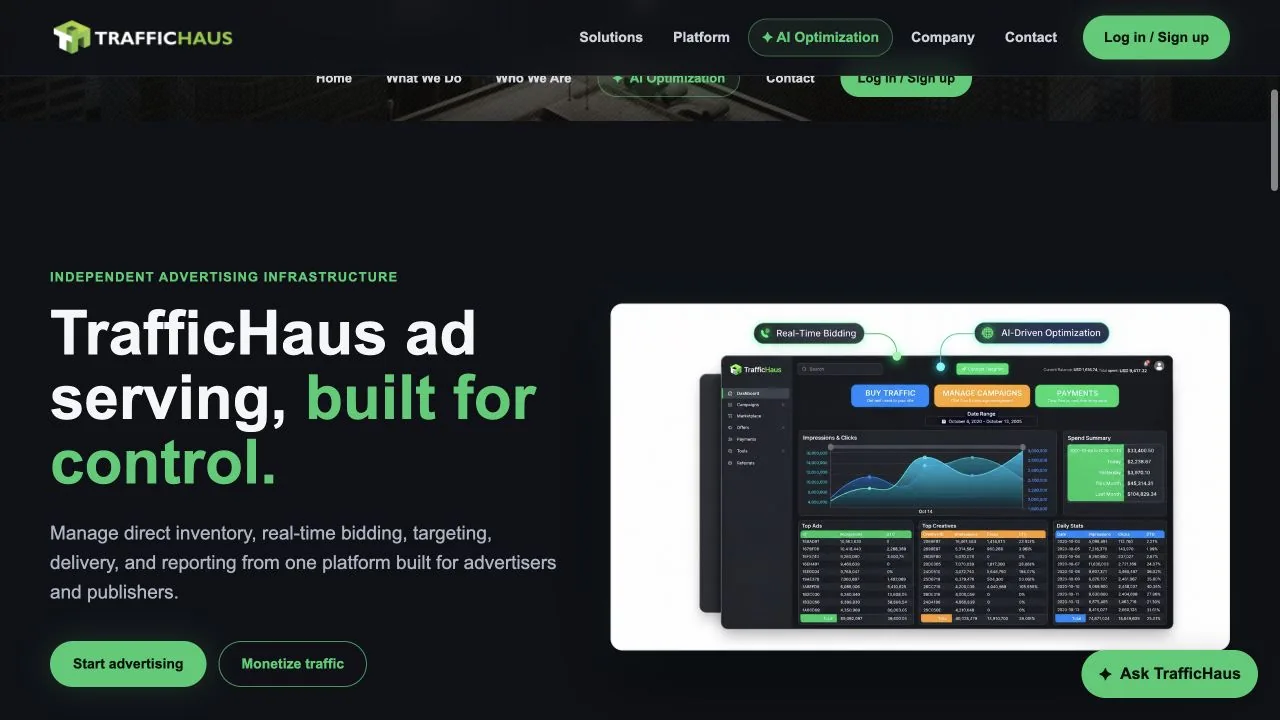
The engineering context
Advertising platforms combine request processing, configuration, integrations, reporting and administration. Changes to one part can affect the people operating another, so feature development needs to account for existing workflows and data behaviour.
The development contribution
Iulian contributed to backend systems, inbound real-time bidding, APIs, reporting and operational maintenance. The work involved evolving an existing platform with contributions from multiple developers. It is not presented as a platform authored entirely by one person.
A concrete example: configuration that survives editing
Work on the native-ad configuration flow included preserving carousel settings when saving and safely representing stored configuration as JSON. These are targeted changes with practical acceptance conditions: settings remain intact and the saved configuration can be used by the rendering flow.
A concrete example: changing an existing request path
Another development change refactored a request path to reduce dependence on an existing ad-server class and use Redis where needed. This illustrates incremental modernisation: change a defined part of the system while accounting for its existing operating context.
The resulting capability
The examples show maintained configuration behaviour and targeted backend evolution in operational software. The scope here is Iulian’s engineering contribution within a wider team; no client source code or internal operating data is published.
Useful changes in an existing platform.
- Reproduce the behaviourIdentify the exact request or configuration path.
- Define the changeKeep the affected scope and dependencies explicit.
- Implement incrementallyEvolve the existing application in a reviewable change.
- Check the behaviourValidate saved settings and the affected workflow.
Engineering decisions that matter
- Configuration round trips. Preserve native-ad carousel settings when they are edited and saved.
- Data representation. Represent stored configuration safely as JSON for the rendering flow.
- Contained modernisation. Refactor a defined request path and its Redis dependency within the existing system.
What transfers to your project
For an existing business application, begin with a defined behaviour, reproduce it and agree how a change will be checked. Modernisation can proceed through useful, reviewable changes rather than assuming that the entire application must be replaced.
Working around an existing application?
Tell us which systems, users and constraints are involved.